Blog

Land of Dragons. Flores Islands

Tweet

That salvia has a deadly cocktail of over 60 bacteria

Published first in Mail Today (Jul 2016)

For the lay, Eat, Pray, Love tourist, Indonesia is Bali and Bali Indonesia. For them it is as if the other 17000 or so islands of this archipelago do not exist at all. But Indonesian islands were to British naturalist Alfred Russell Wallace, what Galapagos islands were to Charles Darwin, both regions helping them formulate their theory of evolution independently.

Interestingly however, in what may be one of the scientific world’s freakish misses, Wallace, who spent eight long years painstakingly studying, chronicling and discovering thousands of species in this part of the world, lived much like the Bali revelers, in complete oblivion of a beast that today is wild Indonesia’s hottest emblem. The komodo dragon, in fact remained shrouded in mystery until as late as 1910, when one of them was killed and its skin sent to scientists in Java.

Today komodo dragons cold-stare you from hoardings, coins, souvenirs, brochures and T-shirts across Indonesia.

Komodo Island. One of the five islands where the dragons dwell

“Komodos here are not tame. Not like in Zoo”. Our guide is at pains to impress on us the ferociousness of the world’s largest lizard. He is one of the many who narrate to us the unfortunate incident of a Swiss trekker who many years ago, went off the beaten path in the Komodo National Park and was made short work of by the dragons.

“It is lucky if you find the komodos and lucky if you don’t”, the guide concludes epigrammatically.

We take it all in, in the 40 minute speedboat ride to Komodo National Park from Labuan Bajo, the largest city in Flores Island, and a springboard for Komodo National Park excursions.

Komodo National Park includes four of the five islands where the dragons live. These four islands are brown with clumps of green clinging only about their coast. A perfect habitat for the cold-blooded that like to sun in the dry savannah grass.

Baby dragons have to keep out of reach of the cannibalistic adults.

The dragons however also sun themselves right on the pier making for a frightful reception committee. However when we alight at Komodo Island, we meet only fork stick wielding rangers at the other end of the long wooden pier. Along with the island’s herbivores; the buffalos, the wild boars, and the deers, humans are also on the dragon’s menu and the forked sticks come in handy to stave them off .

Thankfully on our trek in the savannah , the rangers don’t launch into a maddening dragon chase, a la the tiger safaris in India. Our ranger, like a latter day Wallace stops for every bird sound in the trees and any scampering in the undergrowth. However in the dappled light of the midday sun, the birds are camouflaged and we only get a good glimpse of a brightly coloured jungle fowl.

The ranger then turns his attention to the trees. He tells us in particular about the galand or the palm tree. It’s different from the palm tree whose cultivation has wrecked havoc in large swathes of Indonesian jungles, particularly in Borneo. This one is a wild variant, with no oil, bearing fruits only once in its lifetime. After bearing fruit- perhaps having thus fulfilled its evolutionary duty- it dies. “ There is a soft place inside this tree which is inhabited by geckos and baby dragons”, the ranger informs us. The baby dragons, barely twelve inches at birth, no sooner hatched, scamper up trees like this, to hide from cannibalistic dragons including their mother.

The dragon habitat is surrounded by beautiful coral reefs

“Komodo no good mama no good papa”, as the ranger puts it. The baby dragons live in their arboreal confines for as long as four years until they become bigger, eventually tipping the scale at about 70 kilos. This is when they lose their ability to climb, keeping in turn other baby dragons out of their reach.

A short walk away we see an array of fork stick armed rangers hard pressed to keep a menacing dragon at bay. He swaggers, head swinging from side to side, tasting the air with its forked tongue. Another dragon – the bigger of the two - lies absolutely stationary. From both their mouth drips saliva, which scientists say has over sixty deadly bacteria.

The aggressive one is the female says one ranger. No it’s an adolescent says another. They debate. But soon concede its hard to tell a male from a female. Males in the dragon world however are pretty much dispensable. The dragons are one of those few miraculous creatures capable of Immaculate Conception. In the absence of a male, the female dragon reproduces asexually.

An adult dragon can weigh upto 70 kilos

What made these dragons so big? The dragons are a perfect example of what biologists call ‘island gigantism’. Cold blooded reptiles if geographically isolated for a long time have a tendency to grow larger, while big mammals have a tendency to grow smaller, a tendency the scientists call ‘island dwarfism’. Before man introduced the buffalo, the wild bore and the deer on these islands, the dragons used to feed on the now extinct pygmy elephant.

Wallace, besides chasing butterflies and insects, was always on a look out for fascinating fauna in Indonesia. He found many but missed the most unusual of them all. How the dragons might have shaped his ideas on evolution is only a matter of speculation. But as strange new discoveries continued to be made in these islands east of Bali (the fossil of yet another human species; the Homo floresiensis was discovered here only in 2003) the last world on these islands has not been said yet.

Male: An Island Unto Itself

Tweet


Island of Male, Maldives

(Published first in Outlook Traveller, Jul 2016)


“There is nothing in Male”, everyone barks, astonished that I would want to forgo –even for a day- the hedonistic delights on offer at the resort, to shuffle about in one of the world’s smallest and densely packed cities.

Indeed, it takes a supreme effort of will to drag oneself out of a Maldivian resort’s infinity pool, and the personal butler’s (thakuru) pamperings to venture anywhere. Even to the sea. Most cottages fan out into the turquoise lagoons and from the sundeck, with the beach way behind you, you feel you are already in the waters. So why bother?

Most tourists to the Maldives see and care for nothing besides, whisked as they are from the airport in such an efficient hurry by the resort speedboats, as if to prevent them from wandering into the Maldivian capital, Male, just an island hop away. The perception that Maldives archipelago is just a collection of world-class resorts has therefore stayed.

Thankfully my guide Firdaus is enthusiastic and launches into the history of Male no sooner I am ejected off the resort speedboat into this tiny city. The contrast is indeed compelling and you begin to see why no one wants you to spoil the illusion of Maldives as an ultimate utopia.

From the airport , tourists are quickly whisked away to the comfort of their resorts

Where at the island resorts one is accosted by soft white sands, clear blue waters, tropical trees, coconut with umbrella topped straws and scented damp towels, here in Male, there is just one concrete wall of buildings. Below me, among the fishermen’s detritus, float Coke and water bottles. Male’s architectural element is clearly expediency not aesthetics. The idea seems to be to pack as many buildings as close together as possible on the space-crunched island.

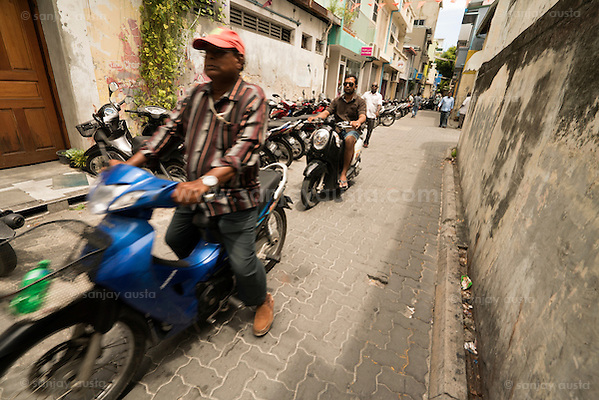
Paucity of space is also why there is a roar of bikes and mopeds on the roads. All solidly stone-paved, the streets are narrow and the two-wheeler is the transport of choice. “If I invite you for a coffee and you see a Maldivian woman and you say, I like her, can you arrange a date with her? The first thing she will ask is do you have a motorbike? The first condition is the bike or else bye bye”, says Firdaus.

But the 1.7-kilometer long and 1 kilometer wide island can as easily be traversed on foot. Every monument, museum and mosque is just an arm’s length away. We first visit the Old Friday Mosque. This once upon a time Buddhist temple was turned into a mosque after the Moroccan scholar Abu al Barakat travelled to Buddhist Maldives and converted the Sultan and with him the country to Islam in the 12th century A.D. The mosque was renovated three times, the last in 1656. It is an important relic of history for all Maldivians. The door and window frames are made from corals. Wooden beams supporting the roof are engraved with Koranic verses but they still hide untold stories of a 1400-year-old Buddhist past. Its a sort of place writer V.S. Naipaul might have wanted to ruminate about in “Among the Believers”, his book about what he termed the “converted people”.

A once upon a time Buddhist temple . Now the Old Friday Mosque.

It is in Male, the mercantile and political centre of the Maldives where you get a glimpse of any Maldivian culture. You may see the Maldivians at the resort’s sand-floor receptions deal coolly with the booking queries of bikini clad Europeans but outside the resorts, Maldivians are conservative and intend to stay that way.

In fact, until the 1980’s the government kept the world of tourists and the world of locals assiduously apart, making the inhabited islands tourist no- go areas. But tourism is Maldivian economy’s backbone, therefore some concessions were made, like modest guesthouses have now been allowed to spring up not only in Male but in many inhabited islands for the bag-packers and the off- the -beaten -path travellers. However the usual tourist debaucheries of winning, dinning, and bikini sunbathing are alright as long as they are cordoned off from the locals.

Every Maldivian is not only a Muslim but also a Sunni Muslim. It’s a paradise where no other religion can be practiced. There are over 35 mosques in the tiny island of Male itself. We visit many of them including the biggest of them all, the Friday Mosque, which pierces the Male sky with its gold-plated domes.

 (sanjay austa austa)

Two-wheelers are a transport of choice in Male

There is a Museum, which is a steel and glass building, a gift from China, built in the year 2010. Among other things, it houses old canons, pictures of important political events and a replica of the pen used to sign the Maldives ‘declaration of Independence’ from the British Empire on 26th July 1965.

Male is crowded with a population of 100,000 people. It’s a tiny landmass that rises up barely one meter above the surrounding ocean. But this is a mere statistics for the Indian traveller accustomed to a sea of people in everyday urban India. In comparison Male looks empty. “ People here take care of their skin and don’t come out in the day. They come out only in the evening for shopping”, says Firdaus by way of explanation.

The fish market at the jetty is a place where merchants from all over Maldives congregate to sell vegetables and fish. I meet Suresh an Indian fisherman from Chennai who says he is not happy with the day’s catch. “The weather is not good. We spent three days out in the ocean and only got this”, he says pointing to a pile of what looked like a good haul to me. There are many Indians like him in Male who earn over 300 dollars a month and visit home once a year.

The fish market here is always busy

Male also has a beach, which is monopolized completely by children. They are minded by Maldivian women, some of whom wade into the waters after their wards fully clothed.

Not accustomed to tourist footfalls, Male offers little choice for souvenir hunters. But there is almost everything to suit almost everyone’s palate and, if you like Thai food, you are in luck. Male, for some reason, has many restaurants catering to Thai taste buds.

But our guide took us to what he called a local ‘hangout’ joint- the Aioli Restaurant, which seemed more popular with the locals for the shisha than its food. The restaurant did not serve authentic Maldivian food but it was a welcome break from the European-dominated cuisines of the resorts. For example, the smoked salmon served there in the breakfast buffet was imported all the way from Belgium, the hostess on duty told me. We went with the recommendation of a skittish waiter and ordered the Hot and Sour Prawn Soup. The soup was great but very spicy. But thats because you are an Indian, explained Firdaus. “They adjust the chillies according to the country you are from”, he said, slurping comfortably on his soup, shisha smoke from another table whirling about his head.

Firdaus my guide who loves Bollywood cinema and many Indian actresses.

From the restaurant and just about at any other street corner in Male, huge posters of Mohamad Nasheed, the popular ex-President sentenced to 13 years in jail, and who recently got asylum in Britain, stare down at you. With him the message of global warming rings ever louder for every Maldivian and the world at large. Should global warming continue at the current pace, there will indeed be nothing in Male in the next two decades. Barely two meters above sea level, Male and all the other 12,00 or so inhabited and uninhabited Maldivian islands will simply go underwater forever.

How to Get Here:

The only direct flights from India are from either Thiruvananthapuram or Kochi. Travellers from any other Indian city will have their flights (on Air India or SpiceJet) routed though one of these cities. SriLankan Airlines and Mihin Lanka offers connections from India via Colombo for about the same price or better and about the same number of flying hours.

Visas :

Visitors don’t need visas to enter the Maldives. Citizens of all nationalities are given a 30-day free visa on arrival, provided their passports are valid for six months, they can show a return ticket and proof of funds or a resort booking.

Lewa Wildlife Conservancy : Reviving Africa’s Rhinos

Tweet

Black Rhino is a majestic beast

Published first in Deccan Herald (Jun 2016)

We had barely brushed the dust off our 45-minutes flight from Nairobi, when we spotted the wallowed-in-the-mud white rhino. A few twist in the dirt road later, our open-sided Land Cruiser came head-on with a herd of galloping zebras. A little further up on the savannah, an elephant family grazed languidly by the flattop acacias. Not far from them, we eyeballed a cud-chewing male cape buffalo. And just a stone’s throw from our camp, we surprised a pride of resting lions. In this 20-minute, airstrip to camp drive by, we had ticked off almost all the African Big Five and many other animals besides.

Animal safaris have often been called voyeuristic affairs. But on the first day in the bush, you expect the thrill of a peek-a-boo not a full monty. With such easy viewing ennui can set in.

To add to that, the lions were all radio collared. Making them look protected and somewhat domestic.

It reminded me of my venerable old guide at Kaziranga National Park, who after a frustrating day of tiger chasing, exclaimed, ‘in Kaziranga there are real wild tigers. Unlike the tame ones in Ranthambore and Bandhavgarh, that any fly-by- night tourist can spot’.

The lions here are everywhere

But we were in Lewa Wildlife Conservancy in central Kenya, a place synonymous with conservation. In colonial Kenya, it was a cattle ranch owned by the Craig family who in 1983 turned the 500 square kilometers property into a conservancy. This was all in an effort to stem the tide of rhino poaching, which had threatened to completely wipe out rhinos from Africa. Little over 30 years, Lewa Conservancy has expanded many folds and has been at the vanguard of providing a safe haven for its rhinos. (Although in 2014 the record was broken when six rhinos were poached.)

Today Lewa has over 75 black rhinos and over 65 white rhinos. The rhinos are not only easily spotted here but are less skittish than rhinos elsewhere in Africa. In Ngorongoro, several years ago, a rhino remained a small fidgety dot on the horizon, which assumed any shape only though my zoom lens. Rhinos have a hopelessly bad eye-sight and as the guide told us, from that distance the rhino probably mistook our jeep for another rhino.

In our evening safari in Lewa, a rhino came so close to our jeep, that to fit him into the frame, I had to switch to a wide angle lens. Led by its enormous horn, the prehistoric beast serenely pushed through the dry and long savanna grass, aware but unmindful of our presence. Over our heartbeats, we heard the crunch of its feet over dry twigs and leaves.

Eland, the largest antelope keep their distance

The rhino was massive but the Indian rhino is bigger and looks more ancient with its armor-plated skin. But both the species evolved almost 50 millions years ago. To be exact more than 48 millions years before humans came into being.

Biologists say, in the evolutionary scheme of things, animals develop traits to counterbalance the traits of other animals in order to survive and maintain that essential ecological balance.

Sadly no species has been able to evolve fast enough to counter man’s rapid evolution from an insignificant cave dweller about eleven thousand years ago to a lethal gun wielding marauder today.

Least of all the rhinos. The demand its horn has spurred a legion of poachers, pushing their numbers to the brink.

In Lewa, the rhinos are well looked after, in the happy marriage of private enterprise and community involvement. Whether it’s India or Africa, the engagement of locals is intrinsic to combat poaching. In Lewa the local community has a stake in keeping the rhinos safe. Their school, their hospitals, their water management programs are regularly funded by the revenue generated by the Conservancy. For its work Lewa was declared an UNESCO world heritage site.

In the Savannah, there is no place for the reticulated giraffe to hide.

The savannas in Lewa are rolling. No matter where we drove there were hills that ran like walls all around and hid animals in their folds. But there was no cover for the reticulated giraffes anywhere. We saw a towering neck of one rising up from behind a small escarpment. There were a lot of dry twisted acacia trees. It was the handiwork of the elephants, our guide told us. Man is after all not the only special responsible for deforestation. There were many acacia swathes in Lewa where elaborate electric fencing was built two meters or so from the ground. This was to prevent elephants from getting in, while allowing passage to other grazers.

We saw two of the largest grazers from the antelope family. The arid specialist, the oryx and the eland; the world’s largest antelope. Camouflaged in the undergrowth we also spotted one of the smallest antelope dik-dik. The Ostrich family showed up with their clutch of nervous chicks that ran helter-skelter between their mother’s stilt-like legs.

Getting a surfeit of Africa’s glamour animals right at the start has its pluses after all. You finally take notice of the other delightful animals in the savanna grass.

How to Get here.

There are regular Kenya Airways flights from Mumbai to Nairobi. From Nairobi one can either drive the 270 kilometers distance to Lewa Wildlife Conservancy or take the 45-minute flight via the small Safarilink aircraft.

These are the smallest antelope and funnily called dik-dik. Yes they are really small.


Another species responsible for deforestation is the elephant.


Maldives: A Paradise on the Brink

Tweet

The water villas are built on a lagoon.

(Published first in Mail Today, Feb 2016)

You won’t find Maldives on an average sized world map. On a large atlas, the archipelago looks like iron fillings strew vertically southwest of Sri Lanka on the Indian ocean.

It’s a short 75 minute flight from Colombo with the ocean obscured by wisps of gossamer clouds for most of the journey. The pilot announces the descent, and as if in a delicious conspiracy, the clouds suddenly vanish, and we get a glimpse of the most astonishing sight we have ever seen. Florescent pools of blue, dot the almost black brooding ocean. These are the coral reefs. They are ring-like with the bright blue lagoon in the middle. On their fringes are beaches, from whom extend cottages built on stilts. These pools, some of them with a smidgen of green, extend far into the horizon that you can only guess at.

Remember when you are flying into Maldives it pays to grab a window seat.

Maldives airport is tiny and with corrugated iron on its walls it has an appearance of a factory from which swarm different nationalities, only to be quickly whisked to the pools of blue that you see from the skies.

Maldives is an archipelago of 1190 coral islands, out of which 200 are inhabited and 105 are luxury island resorts. These resorts are fully sufficient, insulated and built for ultimate indulgence; so much so that it takes a supreme effort of will to step out of these hedonistic cocoons.

The water-breakers may stop the waves but not the rising ocean.

And it suits the Maldivians well because ever since the 1980’s, when tourism took firm root in Maldives, the effort has been to shield the locals from the tourists. Maldives is an Islamic country and intends to stay that way. There are some inhabited island, that now allow travellers to get a cheaper guesthouse accommodation, but the tourist beaches are fenced off so that the five time namaz praying and the hijab donning Maldivians don’t get corrupted by the typical tourist debaucheries of wining, dining, hand-holding and swimsuit sunbathing.

Going by the epicurean Maldivian standards, Meeru Island Resort, where I am staying is not top notch. But it is difficult to imagine how one could improve on the extravagances on offer here.

The roofs are intricate and vaulted from which hang artsy lamps. The restaurants are labyrinthine sprawls with elaborate menus to suit every palate. There are two sand floor receptions. One football field. Three capacious swimming pools ; one for children and one only for adults where women can’t go topless but can saunter in wearing a string bikini if they are so inclined.

The water villas on stilts have a jacuzzi for two. The bathrooms open to the skies and the balcony has stairs that dip down into a shimmering lagoon.

Maldives is only one percent land and 99 percent water.

But to take all this for Maldives is to take the wood for the trees. Lulled by the luxuries, it’s often a mistake many tourists make. For, after all, Maldives is only 1 percent land and 99 percent water.

And despite all the man made extravaganzas on land, they are no match to the splendor of what the ocean hides.

I first hop on a dolphin sighting safari but its often a, you- blink- and- you -miss -it affair. After two hours of keeping our eyes peeled, we see a blur of a dorsal fin.

What is avoidable is the fishing safari. It’s a pretty contrived touristy affair where a boat, all polished and primed takes you to catch fish, not for food but entertainment. The fish wriggles pathetically on the hook after which it is cast back into the ocean. Ironically, in our group, the only fish caught is by someone, who describes herself as a pure vegetarian.

The water in the tropics is nutrient deficient making it transparent and therefore excellent for any under water activity. Face down on a wobbly ocean for my first snorkeling experience, I wonder, as a whole new universe opens up below me, why I never thought of doing this before. Coral reefs are the rainforests of the deep. I understand now why Charles Darwin said they, “rank high amongst the wonderful objects in the world”. There are warrens in the reef that lead to formidable darkness. The iridescent corals shimmer and occasionally small colorful fish sheltered in them wriggle out.

Once islands like Maldives were home to countless bird species. Today they are replaced by countless luxury resorts.

Marine life in Maldives is famously non aggressive. Small but fully formed sharks and sting rays, that frequent the shallows, are completely harmless.

However, if the global temperature keep rising, this paradise would be lost forever. Maldives is the lowest lying country in the world (the average height is 1.8 meters above sea level). Scientists estimate that melting polar ice caps could raise the ocean level by about 2 meters by the end of this century. This would swallow Maldives whole making its inhabitants the world’s first environment refugees. The rising temperatures would also destroy the corals leading to what is called ‘coral bleaching’. Maldives under the charismatic ex president Mohamed Nasheed, pledged to become fully carbon neural by 2019. But the rest of the world has to follow, else the iron fillings would be erased forever from every atlas.

Marine life including sharks in Maldives is surprisingly non aggressive.


Maldives has some of the finest resorts in the world.


Dolphin sighting is a blink-and-you-miss-it-affair, so the tourists turn their cameras on one another.

The beaches are beautiful but nothing compares with the marvels the ocean hides.


Snorkeling or scuba diving, the island provides very good sighting of corals reefs.

Wild In Borneo

Tweet

The proboscis monkey, endemic to Borneo.

(Published first in the Deccan Herald, Feb 2015)

It is fitting that it rains on my visit to Borneo’s rainforest and I get somewhat drenched despite the wafer thin ponchos that wrap me till my knees. It is fitting too that Celina my guide is a member of one of the island’s many tribes. Unlike travellers or the scientists who fly into Borneo, Celina has a more intimate connection with the creatures of the forest. Her tribes, in the manner of most tribal societies, name all their deities after the animals the birds and the trees.

And Borneo has a plethora of each of them. Geographically isolated from the rest of the world for the most part, many of them are endemic-including 44 mammals, 17 birds and 155 dipterocarp trees. The diversity of flora and fauna in this world’s third largest island is staggering, so much so that new species are discovered here each year.

I am in Sarawak, the Malaysian part of Borneo where I am visiting the famous Bako National Park, one of the many national parks in Sarawak, where a lay tourist can get a fair sampling of Borneo’s immense bio-diversity.

A wooden causeway suspended about a foot from the ground leads us into Bako. It is not exactly my idea of a rainforest walk. But that’s the best option when the forest floor is wet with water collected in small leaf filled pools. The sky is overcast but even if it was a clear day, sunlight has no chance of seeping in though the thick canopy. Perhaps that’s why trees, many of them a variety of durians, stretch tall and disappear in the thick foliage of other trees overhead. However the star animals of this island are two primates; the long nosed proboscis monkey and the orangutan, both of whom we hope to get a glance of.

The orangutan with whom we share more than 28 unique physical characteristics including an opposable thumb.

But to scamper about in a rainforest in a mad rush to see prize animals is to miss the point. A rainforest is not the African Savanna where you come to tick off the big five or marvel at the stampeding herds. In fact you may not see very many species at all. But they are all there. Many of them hidden in the thick multitier canopy. Many others concealed in the thick undergrowth.

However when you let the rainforest open unto you, you realize that the forest itself is a primordial beast heaving with its own cadence and rhythm. In the silence you are overwhelmed by the persistent bell like sound of the cicadas broken only by the sounds of crickets. The forest is still but crawling with the little things that are so beautifully camouflaged that without a guide you would miss them altogether.

Celina points out to us a green tree pit viper on a tree trunk twisted upon itself, green as the leaves behind it. It is frozen and its golden eye unblinking, glazed and cold. It is a tiny creature but its venom packs a punch. What a fright to realize that these tiny reptiles could be hanging from any branch above us.

The venomous pit viper

But the sight of a marsupial colugo or flying lemur cradling its baby has us throw caution to the winds as we follow other shutterbugs for a closer view. We leave the security of the wooden pathway and trapeze on the forest floor- crushing twigs and brushing aside branches much like the ones on which the viper perched.

The colugo is a ball of fur suspended upside down, seeking us out goggle-eyed. The baby occasionally joins in the staring before retreating to the safety of its mother’s belly. The mother unfurls her wings laboriously once or twice and tries half-heartedly to get away, stretching out to find a suitable purchase on another tree trunk. Though an excellent glider, colugo is a clumsy tree climber and after what seems like a lot of effort it manages to disappear behind a tree trunk. We return having spent close to half an hour on the colugo, but the viper had not moved an inch in the interim.

Borneo has its rhino, its clouded leopard and the pigmy elephant but the primates remain its signature species. It is home to over 20 of them. Celina spots the endemic proboscis monkey close to the Bako center where it rests on a tree turning this way and that, visibly languid in the hot humid midday sun. It’s nose, after which it got its name, hangs over its face like an overripe fruit and comes in handy, as they say, in attracting mates.

 (sanjay austa sanjayausta@gmail.)

The cologo or the flying lemur with its baby

We see more of the proboscis monkey in the evening in the mangrove forests skirting the South China Sea. They crash about the branches looking for succulent leaves, surprisingly agile despite their potbellies.

The most charismatic animal on the island is however the orangutan, an ape we share 28 unique physical characteristics with, including an opposable thumb. The Orangutan Conservation Area in Sarawak rehabilitates orphan orangutans often those whose mothers were hacked to death by machete wielding men. The plight of these remarkable apes perhaps best epitomizes the state of Borneo’s rainforest, which is today barely one third of what it was 30 years ago.

The deadly scorpions scamper everywhere on the forest floor.

Large swathes of Borneo’s forests have been cleared for timber and for the cultivation of palm oil or ‘green gold’ as its known for the lucrative value it fetches around the world. Borneo, one of the world’s, most diverse ecosystems is in danger and with it the existence of the so many unique species of animals and trees hangs in the balance. Also in danger of extinction are the unique way of life of the indigenous tribes like the one to which Celina belongs. For centuries they have lived in complete harmony with nature.

Demands fuels supply. And the best one can do on an individual level to save these rainforests is to eschew the use of palm oil. Another remedy is to visit these forests insuring a steady footfall that will stop deforestation and fuel conservation.

 (sanjay austa sanjayausta@gmail.)

Fishing in the South China Sea.

Sex and the Indian Journos.

Tweet
Untitled-1

Yearly ‘Sex Surveys’ by magazines are now a norm.

(Published first in The Hoot Feb 2016.)

One of the many books I ordered from Amazon to read in the new year was journalist Avirook Sen’s book, ‘Aarushi’ . But frankly I had no intention of going anywhere near it until I had ploughed through books on my current passion- astronomy and evolutionary biology.

So ‘Aarushi’, with the rather unimaginative cover (embossed blood drops) lay buried under E. O. Wilson, Carl Sagan, Jared Diamond, for most of January. It was rescued from the heap when I attended a panel discussion at the 2016 Jaipur Lit Fest, where senior journalist Madhu Trehan remarked that, had Avirook been in America, he would have won the Pulitzer !

Being a sucker for phoren validations, I quickly substituted the big-bangs, worm holes, gene pools, and natural selection for the hurly burly world of crime, cops, hacks and sundry inanities.

The book is deeply distressing. You come away thinking that god forbid if you are in a soup one day, there may be no hope. The cops are incompetent and will screw you if they want to screw you.

Our so called forensic experts, who can harness the wonders of science to silence conjecture are either bumbling fools or can easily be tutored to present their findings anywhere the strings are pulled.

Screen Shot 2016-02-10 at 9.03.14 am

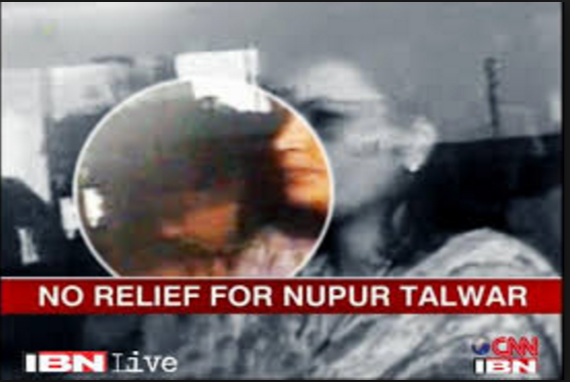
Nupur Talwal who the media said did not cry that much.

And the courts, the last bastion of remedy and redress can sometimes arrive at a judgment even before the defense has completed its arguments. (Presiding over the Aarushi-Hemraj case, Judge Shyam Lal began typing out the judgment even before the Talwar’s lawyer had begun making his final arguments, claims Sen).

But what really got my goat was the role of the media. In every whodunit cases like this, the media has been held by the scuff of its neck as it were and made to sniff any shit the cops chooses to shove its way.

Covering crime is a right of passage for any reporter, so I too have had my brush with the crime beat. It usually goes like this. Someone is murdered. You go to the scene where the cops officially tell you one thing. You talk to the relatives, neighbors and other players and they each give their versions. But you also have some ‘source’ (who conveniently goes unnamed in all your stories).

The ‘source’ usually calls you up with a leak . Even if it is freakishly absurd you feel privileged with the info and go to town with the ‘exclusive’.

Screen Shot 2016-02-10 at 9.36.17 am

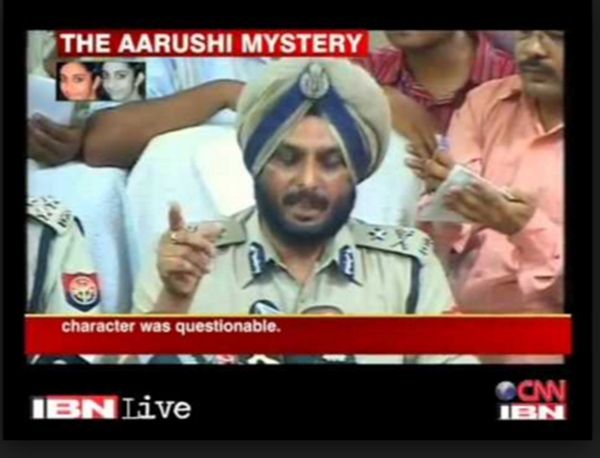
Gurdarshan Singh (IGP), calls the 13 year old Aarushi ‘characterless’ and the media lap it all up.

You would have to be a nincompoop be believe that the scurrilous stories of orgies and wife swappings concerning the Talwars had something to with the twin murders, even if they were true. But they were served up that way by the cops and the media faithfully presented them as facts, insinuating by extension that the Talwars were guilty.

Why does the media obsess with sex so much? Writing about the blundering cops, Sen quotes senior journalist Vir Sanghvi.

“This is not a sex crime So why is the Noida police going on and on about sex, ruining the reputation of the dead and the living without a shred of evidence?

My guess is that they are not just incompetent, they are also sex starved. Perhaps the IGP needs professional help”.

Screen Shot 2016-02-10 at 9.07.40 am

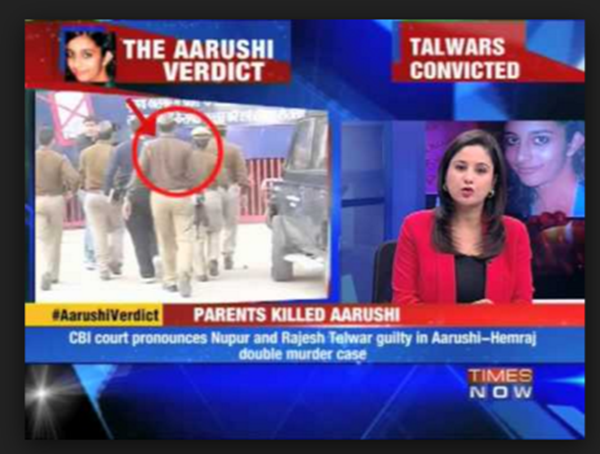
Channels like Times Now said they felt ‘vindicated’ after the guilty verdict.

Sanghvi could well have been talking about his own reporters on the case or about journalists at large. Journalists like cops are sex starved and any whiff of sex will get them into a mad frenzy. And the cops know this only too well. They both after all feed on the same dirty dish.

Spend any length of time with a group of journalists and the topic of sex somehow always wafts up like the putrid passing of wind that everyone at the table wants to acknowledge. It is usually gossip about the sexual prolificacies of the rich and the famous and has the usual cast of characters including Amitabh Bachchan, Aishwarya Rai, Deepika Padukone, Sachin Tendulkar etc. etc. Stories of their sexual escapades are presented in lurid details and embellished with each retelling. The stories are not offered as light hearted blather mind you, but as facts and upon journalistic authority and ‘first hand’ information.

Most journalists, unlike maybe the jet setting Sanghvi, come from the middle class and represent middle class values and obsessions. They like to believe in the salacious exploits of others because these stories makes them feel better about their own sexually repressed lives. Nothing makes the middle class feel more moral than when they discuss the sexual immoralities of others. Outrageous sex stories about the celebrities bring them down a peg or two and make them look more human. And this is helpful because journalists brush shoulders with the famous but can never actually be them.

Screen Shot 2016-02-10 at 2.19.24 pm

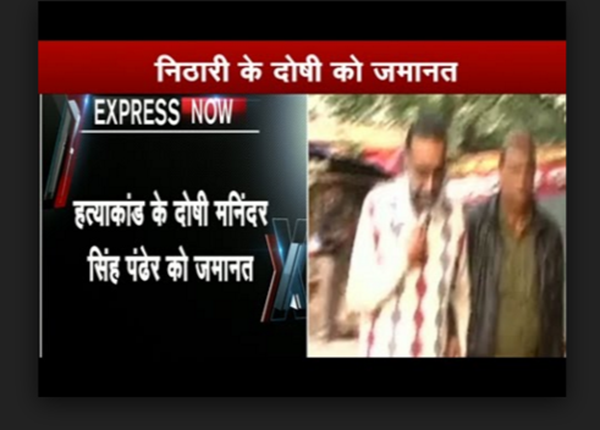
Moninder Singh Pandher’s dissolute life which made the media link him to the murders.

It would be okay if the journalists stopped at being just prurient purveyors. God help you if you are accused of any crime and you have had an extramarital fling or two or if a stash of Sunny Leone porn is found on your laptop. Your sexual peccadillos will be paraded as proof of your guilt. You- do –sex- so- you -must -do -murder-too is the harebrained logic. Never mind if the narco analysis does not suggest it, or there are no eye-witnesses, or if your finger prints are not there, or as in the case of Moninder Singh Pandher, - co-accused in the infamous Nithari serial murders- you are not even in the country when the murders take place.

The Pandher case is another sad example of miscarriage of justice brought on by a sustained media’s trail that careened out of course because of sex. Pandher was made a villain by the media after his appetite for prostitutes came to the fore. The dots from debauchee to murderer were joined quickly even though the CBI admitted it had not a shred of evidence linking him to the murders.

A job of a journalist is somewhat like that of a scientist. You claim something only if you have the facts. Aristotle asserted as far back as 340 BC that the world is round. But he did so only after painstaking calculations and observations like for example how one sees the ship’s sails on the horizon long before one sees the hull. Journalists spot a convict even before they have surveyed the crime. In the 21st century India we journalists need to banish ourselves from the flat world we inhabit. More importantly, while reporting, we must keep at home our middleclass morality, so we can see not in blinkered binaries but in multi shades of grey.

Annika Roser and Boudoir Photography. Is India Ready for it ?

Tweet


The story first appeared in the Deccan Herald, June 2014.

“I must warn you. You may find the images offensive”, she says, handing me her business card over dinner in one of Jodhpur’s splendid open-air restaurants. American photographer Annika Roser, 25, has just told me she specializes in boudoir photography.

For the uninitiated, boudoir photography simply means taking pictures of people in the nude or semi nude for sensual or erotic appeal. It is pronounced as you would pronounce Wednesday in Hindi with an American accent.

I am a bit hurt for being taken for an average Indian prude. Defensively, I fill her in on the debaucheries of Khajuraho, the Hindu tradition of nude sculptures and paintings , (including of our gods and goddesses). I mention Prabuddha Dasgupta and I mention Sunny Leone.

Indian photographers (most fashion photographers at any rate) have indeed been doing a variant of boudoir alongside their main work all along. In their website’s drop-down menus, ‘personal’ is an euphemism for nudes. But the women gracing their galleries are professional (or wannabe) models who have often been cajoled or paid to pose in the buff.

In Boston, US, where Annika lives and has her studio ( Ma Cherie Studio) , it’s the other way around. Women pay her to shoot them in all manner of undress. She charges 450 dollars for two hours of shoot time. And these clients are not professional models but regular American women ; school teachers, doctors, housewives and just about anybody with a desire to look beautiful.

“Today’s society weighs women down by constantly forcing their idea of true beauty upon us. Boudoir photography is a celebration of the female form, no matter what size, age, ethnicity, or social class the woman ”, she says.

The celebration of female form has been a tradition in India , long before boudoir photography began in the West . But keeping that tradition alive have been our painters and sculptors. Not photographers. While painters like Raja Ravi Verma and Amrita Shergill and thousands of nameless sculptors of Khajurao and Konark, depicted the full bodied Indian women in all their voluptuous glory, Indian photographers, including the best of them, like the late Prabuddha Dasgupta , only ended up stereotyping Indian women into a certain body type. Their ‘personal’ galleries sadly imitate and perpetuate a western notion of beauty with their skin and bones models.

Boudoir, thankfully can reverse that trend. But will India take to it? India has been slow on the uptake but once it warms up to a photography genre, it takes it by storm. We saw that with wedding photography. Till about 10 years ago, everyone was happy with their regular wedding pictures but today anyone with money, is willing to throw obscene amounts of it, to hire, what in India is called, a ‘candid wedding photographer’, propelling many a software engineers and B- school pass outs to quit their jobs to become one fulltime.

And Annika with her 5 years of experience believes boudoir can be done in any part of the world, including India. She wants to test the Indian waters by coming here this winter.

Is it easier, however to be a boudoir photographer being a female? Annika admits that to to start off, it helps. “ But I know a lot of men who are doing boudoir photography now, and at times I feel that the male photographers provide a different look. They understand how men look at women and what other men would like to see. They can show off the female form in a very different way from a female photographer. I do not personally think that one way is better than the other, but its more of a personal preference for the client of whom they are comfortable with”, she says.

The most vital element of boudoir is the pose, says Annika. “With boudoir photography, you always have to pay attention to the pose. It is the most important thing. Since there are no clothes covering or hiding the body, you as the photographer have to pay attention to every little detail. I think, that is what makes boudoir such an interesting form of photography”, she says.

Annika does not only take the photos but offers to go out shopping for props or lingerie with her clients. “I approach my clients as if they were one of my close girlfriends and we are just hanging out playing dress up. I talk with them a lot, often sharing personal stories”, she says.

Being constantly bombarded with images of anorexic models, the fashion and the advertising industry, often contributes to body-image issues in impressionable girls. Boudoir with its depiction of everyday woman, can perhaps do a bit of course correction. Annika, thinks that with boudoir’s popularity women will realize they don’t have to look like the aseptic models in magazines and that they can be comfortable how they look and embrace their individuality.

And the gorgeous Annika Roser herself

Living with Leopards, Rajasthan

Tweet
 (sanjay austa sanjayausta@gmail.)

As the sun goes down, the leopard emerges.

(Published first in Deccan Herald, Sep 2015)

I wake up at the crack of dawn with strange bedfellows. An arms length away is a three-month-old calf. Further away under a tree swishing its tail feverishly stands a black horse. Perched on the trees are desi hens and somewhere on the ground hobbles an injured eagle owl- called Ganguraja.

Just beyond the wall of this menagerie that is Raju’s courtyard, is an outcrop of rocks I can see lying prone on my string cot. Somewhere in its fissures lives a leopard (or panther as it is referred to in these parts)

Despite the assurances, it is not easy sleeping out under the stars barely 50 meters from the leopard’s lair. I startled myself awake several times in the night to the mating croaks of frogs and the impatient stomp of the flea-harassed horse. My host Raju, 21, slept like a corpse, tucked in his cot with a red shawl, from head to foot.

The only comforting sight was the tawny calf. The leopard would definitely pick him over me I told myself as I tried to sleep.

But except for the infernal din the rooster has begun to raise, it is all peaceful in the morning. I walk out of the courtyard and see Raju’s cows . They are tethered just a bound away from the leopard’s hideout. Can it really be true as Raju claimed that the leopard comes at night to drink from the cattle trough?

Raju, tousle-haired and sleepy-eyed emerges with a plateful of dried corn. “Lets go. Its time”, he announces indicating to the outcrops. This is nothing but foolhardy. We are heading to the leopard’s den. We cover the short distance and climb the rocks. Raju clambers up with practiced ease and is soon on the top scattering the corn. Peacock feeding is a family tradition. His father did it regularly, taking him along and now after his death Raju has taken his mantle. He is often joined by his 12 year old brother Manhoar and six year old sister Pranchi.
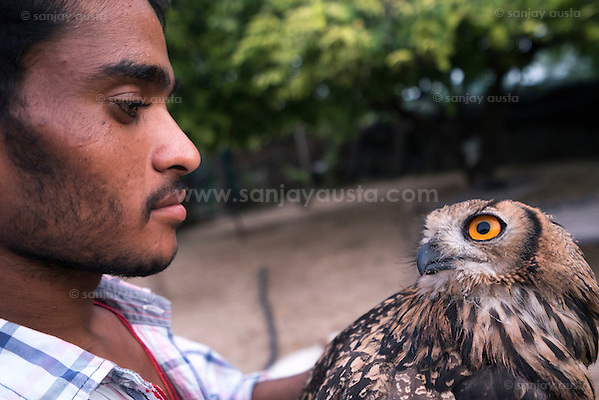
Raju with his injured owl Ganguraja. The Eagle owl, Rajasthan (sanjay austa)

Raju with his injured owl Ganguraja.

Raju indicates a cleft in the rock below us barely a few meters away. “This is where the panther shuts himself off during the day”, he says sitting down. Heralding the dawn, the sky in the east is just beginning to turn from pale pink to orange. It’s time for the leopard to return from his nocturnal hunt. What if it comes now as we sit few feet from his den?

“Let him come. He will go into that crack what else”. he says. Won’t he feel threatened by our presence? “He has seen me many times with my siblings. He knows we mean no harm and he won’t have his guard up”, he says.

The previous evening just after sunset I had my first glimpse of the spotted cat from Raju’s house at almost the same place where we were now sitting. The feline head was silhouetted and it was surreal to watch it merge into the blackness of the sky.

There are more than two dozen villages like Raju’s scattered over 11 panchayats in Pali district in Rajasthan where people have lived in eerie harmony with the felines. The rocky outcrops in which the leopards live, stand like islands in their fields. The farmers tend to their crops with the confidence that can only come with complete trust.

There are many like Raju who have their houses next to these outcrops and see the antics of the leopards everyday from their rooftops.

Peace has prevailed for generations. Occasionally a calf or a goat is lifted and sometimes even a cow but unlike in other parts of India, the cattle carcasses are not left poisoned for the predator. This is surprising as the compensation offered here is paltry. Five thousand for a cow and one thousand for a goat.

The leopard had entered Raju’s courtyard just a few days ago and made away with one of his hens- (perhaps the reason why the hens have taken to sleep in the trees.) But Raju downplays it. “A young leopard learning to hunt sometimes may do that. It’s a rare event. And anyway it was just one hen”, he says. There is no compensation for hens.
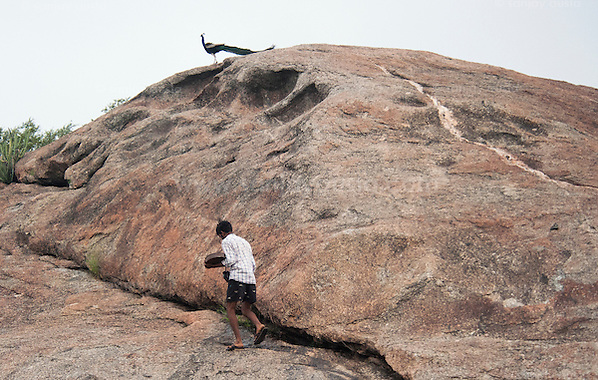
And in the morning Raju scampers up the leopard's den to scatter bird-feed for peacocks. Heerola. Rajasthan (sanjay austa sanjayausta@gmail.)

And in the morning Raju scampers up the leopard’s den to scatter bird-feed for peacocks.

Raju perhaps best epitomizes the unique respect for the wild that is characteristic of this region. After his father’s death a year ago, the burden of providing for this family rests on his shoulders. He has grown up sisters but the Rajput clan they belong to forbid women working in the fields. He has to work singlehandedly to make ends meet but that does not stop him from feeding almost half a kilo of dried corn to the peacocks every morning. It did not stop him from adopting Ganguraja the injured owl for whom he buys 100 rupees worth of liver every day.

It was 20 years ago that a leopard picked up a child in this region- the only incident of its kind. In Vellar village not far from Raju’s own, lives Santosh Kunwar Chauhan , 20. She was barely one year old when a leopard scampered down from the rocks and picked her up. Vellar village fringes the hillock inhabited by leopards. Santosh’s house is on the outer fringe.

“It was about 9 in the evening. We were sitting in our homes when a panther picked her up from her neck and scurried away. We made a noise and the leopard immediately dropped the girl near a temple. It looked confused and then ran up the slope. Santosh was crying. There was a deep flesh wound on her upper back from the canines. We took her to the local hospital, where after administering some first-aid she was okay”, says Ranjeet Singh, 60, Santosh’s chacha.

Santosh has teeth marks to show for the story. There is a blackish sutured smudge on her upper back. Her life did not change except that she was given the nickname Setri- the local word for a female leopard.

Ranjeet and other village elders who were witness to this event are more inclined to blame themselves than the animal. “ Santosh was wrapped up in a bundle and lay out in the open near the cattle shed. The leopard could have easily mistaken the girl for some other animal. She should not have been kept there”, says Ranjeet.

Santosh’s lifting up is seen as a freakish event rather than a future possibility. The children as small as two years play about in the same spot and beyond from where Santosh was picked up. There is no fear. There is only a calm acceptance of how nature works. The occasional calf or goat that is preyed upon by the leopards is taken in the stride as though it was an offering to the Gods.

Santosh summed up the attitude succinctly. “ The leopards don’t eat grass. It has to eat flesh so what’s unusual about it”.
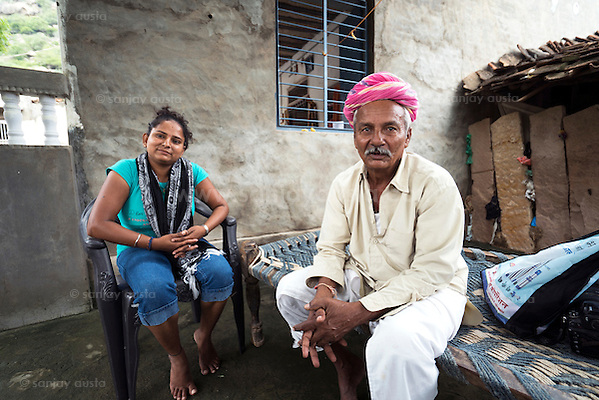
'' I live here so how can i be scared', says Santosh, 20, who was picked up by a leopard near this house when she was a baby. That incident is the only cat-man conflict in the last two decades. Here people have learnt to live in complete harmony with the predators. Vellar. Rajasthan. (sanjay austa austa)

Santosh, 20, who was picked up by a leopard near this house when she was a baby.


“People here have traditionally accepted the leopard’s ways and they don’t react violently if it does pick on their cattle”, says Rahul Bhatnagar, Chief Conservator Forest, Udaipur Divison.

Thankfully however the favorite animals on leopard’s menu are not the farmer’s cattle but dogs. And there are many a proliferating packs of strays in the region which have fed a legion of leopards since decades. The dogs are preferred even over the other wild animals found here like the neelgai, the wild boar and the chinkara. The donkey makes the second best choice.

“The leopards here are almost like pets. They seem tame but are wild all the same. But the harmony between man and predator here has lasted because there is no disturbance from either side. In the day the leopards lie in the caves and the shepherds are outside but neither disturbs the other”, says Jaswant Raj Merwar, Pradhan of Samunderi village.

The famers here who grow cotton, maize, wheat, mustard, groundnut infact welcome the leopards presence. The big cats keep the neelgai, the wild bore and other herbivores that raid their fields, tucked away in the forests.

But could the menacing march of consumption couched in slogans of ‘development’ engulf this unique leopard habitat one day? The day I arrive at the Jawai Dam area, the forest department was in a huddle over a leopard’s death. A big healthy male leopard was found dead on a transformer. “Apparently he was chasing a peacock and he jumped on the transformer after the bird , electrocuting himself. The body was found almost three days later by school children”, said Narpat Singh, range officer. The body, bloated disfigured and swarming with worms raised a nasty stench.

But the biggest danger is the mining lobby which has set its eyes on the vast riches of granite and other stones this area is replete with. There are more than 140 proposed mines here. The forest department gave NOC for mining for some of these mines. Because of the objection raised by the villagers the state government overturned the NOC and put a ban on any mining in the area. Conservationists and forest official agree that the only way to safeguard this unique leopard habitat is to make it a community reserve area.
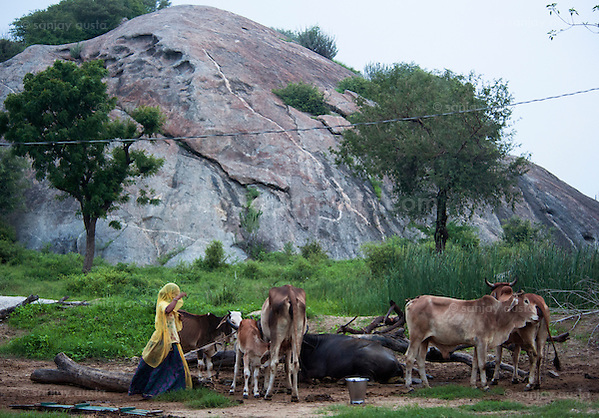
Under this rocky leopard's lair are tethered Raju's cows. The leopards surprisingly don't touch the cows even though they come at night to drink from their trough. Heerola. Rajasthan. (sanjay austa sanjayausta@gmail.)

Under this rocky leopard’s lair are tethered Raju’s cows.


“If the area is declared a community reserve, there won’t be any mining. There will be rules for building hotels. The leopard is a shy animal. Any commercial activity here will drive it away”, says Shatrunjay Pratap Singh, 31, a conservationist and hotelier belonging to this region.

Besides stopping the mining and construction it will regulate and restrict the flow of tourists which can often get out of hand.

“A lot of people from nearby towns and beyond come in droves during the weekend. They make a lot of noise often throwing stones in the caves if they don’t see the leopard. This should stop”, says Shatrunjay.

“ If there is a community reserve the tourists can be ticketed and the revenue collected can be used to dispense compensation if any cattle is taken by the leopard”, says Rahul Bhatnagar.

However only three panchayats out of the 11 have given their approval for a community reserve so far. Shatrunjay says that mining lobby is working overtime with its propaganda, misleading the villagers. The battle is on and no one knows which side it will swing.

This is a unique leopard habitat. It’s a place where leopard sightings are a matter of course. Serious wildlife enthusiasts, conservationists, filmmakers and photographers are drawn here from all across the world. One evening, I join a group of wildlife photographers and sit for hours in the bushes waiting for the leopard to emerge from the hillock across.
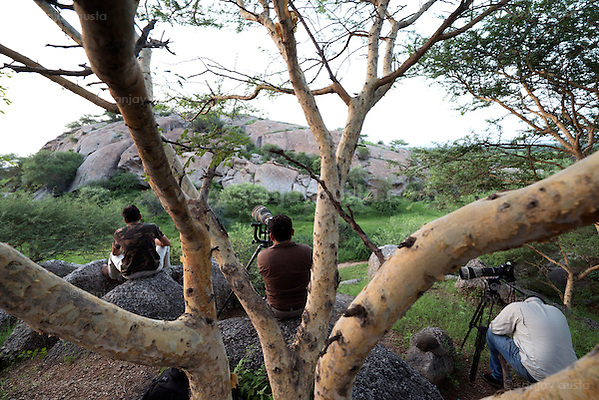
Wildlife photographers wait for the leopard to emerge from its den in Bera, Pali District, Rajasthan (sanjay austa austa)

Wildlife photographers wait for the leopard to emerge from its den in Bera, Pali District.


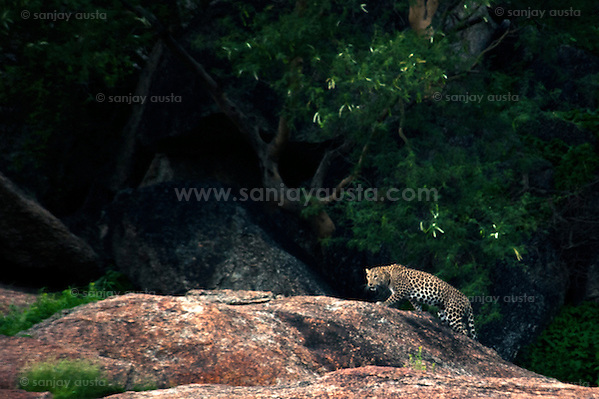
At first it seemed like a fruitless exercise. The sun was already low on the horizon. The granite rock-face before us betrayed no sign of the leopard and I had gotten wary of staring at nothing. There were no alarm calls by the peacock. A stripped hyena walked lazily by the foot of the cave. But like clockwork, just as the sun was poised to disappear beyond the Aravallis, a leopard emerged. The photographers said it was a female leopard. They had photographed her with two cubs in the morning. The big cat sat on the rock majestically surveying the lands swaddled now in the golden glow of the setting sun. It comes as a shock to realize that its rock faces like these that the mining companies are eyeing. Not far were farmers in their fields wrapping up for the day. Its reassuring to see them and to be secure in the knowledge that as long as their love for the cats remain this unique leopard habitat will survive.

But this remarkable attitude towards the wild percolates much beyond Pali’s borders. The Bishnois of Jodhpur who worship all life and would give theirs to save any animal, is legendary. In Jodhpur district there is a wildlife vigilante group called Bishnoi Tiger Force- that is a menace to any poacher prowler. They undertake daring animal rescues battling gun-wielding poachers in the dead of night. In Kichan, a nondescript village in western Rajasthan the villagers feed sacksful of birdfeed to the migratory demoiselle cranes who fly here in their thousands in winter, all the way from Mongolia. 30 kms short of Bikaner on the Jodhpur- Bikaner highway stands the famous Karni Mata Temple which is overrun by rats that are revered as gods. There are remarkable individual stories like that of the 77 year old Ranaram Bishnoi of Ekalkhori village in Rajasthan who singlehandedly planted over 25 thousand trees to stop the march of the desert or of Kiran Bishnoi the famous Bishnoi woman who breast fed a chinkara kid when it lost its mother.
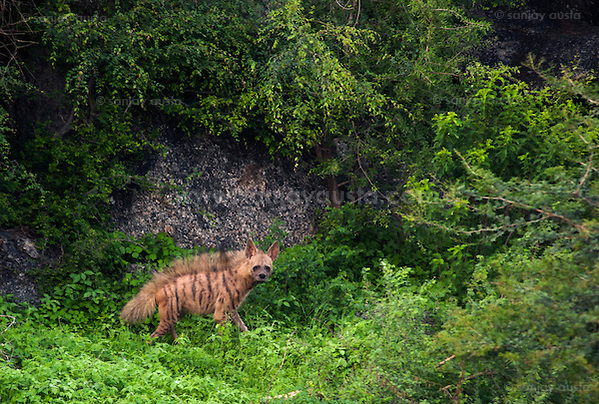
The elusive striped hyena in Rajasthan (sanjay austa sanjayausta@gmail.)

The elusive striped hyena walks by the leopard’s den.
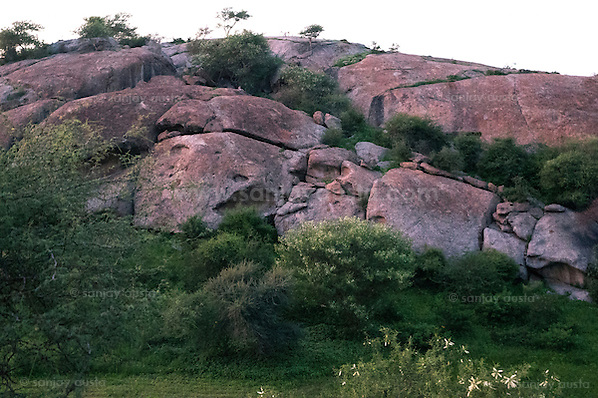
 

The leopards living in these rocky outcrops that sit in the middle of farmers fields. Pali District. Rajasthan (sanjay austa)

A leopard lords over the rocky outcrop where it lives
Ramche- A Pastoral Hideout in Nepal

Tweet
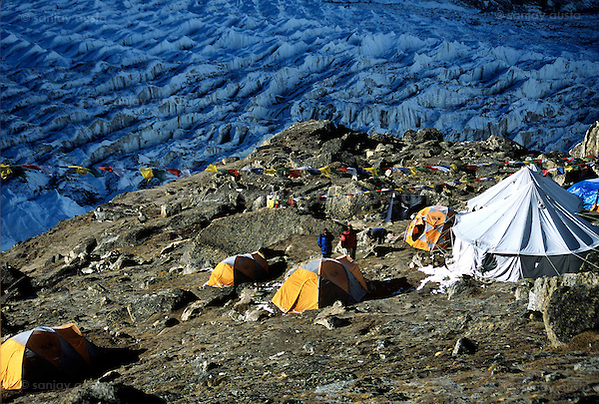
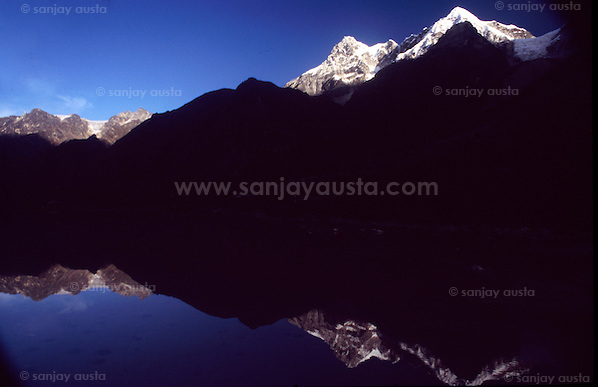
Yajung glacier and the Base Camp. The Yalung glacier was right below the big mound where we had our Base Camp. The sunlight reached our camp first in the mornings and in the shadow the Yalung Glacier looked deep blue (sanjay austa austa)

The Mighty Yalung Glacier at the Base Camp, Kanchenjunga

(Published first in the Mumbai Mirror, July 2015)

One of the enigmas of travelling in the Himalayas is that the higher you go, the wider the valleys expand. The snow- eroded slopes are steep but even. There are vast vistas of space and everything is far out in the distance. The feeling is that of expansion rather than being hemmed in.

However, somehow all my trips to high altitudes have been shortcuts. I have ascended up Himalayan heights ascending to an altitude of 4000 meters or more, propelled by an aircraft.

So too with Ramche in Eastern Nepal where a Mi-17 helicopter dropped me and two dozen army men on a vast valley floor. Ascending so quickly from Taplejung -a shabby Nepali village- I stood for several minutes, gasping the oxygen depleted air in awe.

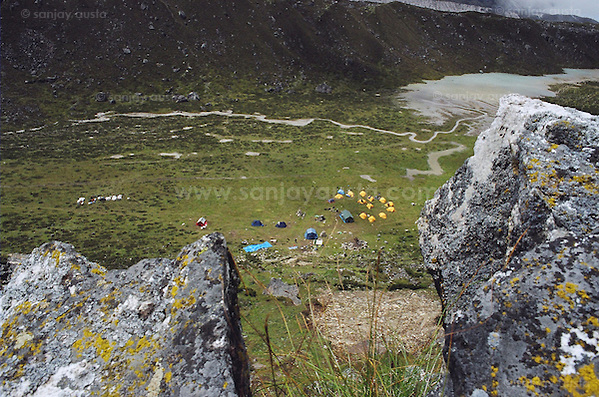
Who would have imagined this idyllic pastoral hideout up in these virtually inaccessible Himalayan heights? But as I explored, I found one vast valley tucked behind another. Dotting them, herds of yaks grazed on the sparse short grass. Glacial streams snaked in the valley from everywhere forming a sort of estuary at the Ramche lakes.

Our camp at Ramche and the glacial lake. I took this pic on my trek on the mountain alongside our camp. The best way to accamatise to the high altitude is climb the mountains as high as you can and return to the base camp. This prepared you to make the final bid to the top. (sanjay austa austa)

Glacial lake and our camps, Ramche

Ramche at 4300 meters is far above the tree- line, with treeless mountains. However bonsai version of rhododendron grows thickly on steep slopes. It is an aromatic shrub, which the nomadic shepherds, the only humans who live in this part of the world, call sunpati. They use it for incense in worship. The other bush that grows on the mountains is juniper. The yaks don’t feed on the leaves of these plants -perhaps due their aroma; they instead nibble on short grass wherever they can find it.

The mountains themselves rise almost abruptly at the edge of the valley floor. Beyond them loom some of the famous Nepal peaks.

I was accompanying a team of hardy Indian Army mountaineers who focused on their goal ; summiting Kanchenjunga peak, had little time for mountain romanticism. For them Ramche was just a convenient broad strip of land, perfect to land the helicopters on and to pitch tents and stock supplies for the expedition.

One must rest at least a day after a sudden jump from low altitudes. But at Ramche, with so many spectacular bounties on display, I did not think I was any worse for wear. There was a low mountain wall that ran along the length of the valley to the east. No sooner we arrived , there was enormous curiosity on what lay beyond this wall. The Sherpas said there was a glacier.

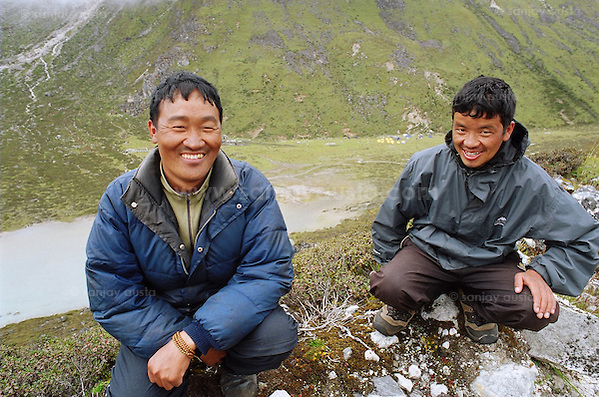
Two sherpas i meet on the ridge on my walk exploring Ramche (sanjay austa austa)

Sherpas on the expedition, Ramche

This juniper-clad mountainside was a mere hundred meters tall but not sufficiently acclimatized, I was badly winded by the time I reached its rim.

But where was the glacier? Unlike Greenland, Iceland or Alaska, much of the Himalayan glaciers are buried under heaps of mountain debris. From a distance you only see the moraine of dry stone-strewn valley. But the Sherpas pointed out to us the snot-green glacial pools. We were looking at the Yalung glacier. Even with our layman’s knowledge we could see that it was a glacier in retreat. Further down the valley the mountainsides carried the scars of the once-flowing glacier ; lose earth and gravel was scratched with layers exposed in lateral patterns.

But further up the mountains, which we climbed the subsequent week, we saw the Yalung glacier spread out lavishly. However again, the crevasse-riddled surface was peppered with glacial pools, a sign that the glacier was melting faster than it should.

Himalayan glaciers present a big challenge to climatologists and glaciologist because of the inhospitable terrain.

“Compared to other parts of the world glacial monitoring in the Himalayas has not been done It’s a tough inhospitable terrain. The cost of study here is substantially higher. The glaciers are in retreat due to climate change but we need a lot of sustained research to estimate just how much”, says Ugan Manandhar, WWF, Climate and Energy Program Director.

Though the Intergovernmental Panel on Governmental Change (IPCC) has debunked the claim that all Himalayan glaciers will disappear by 2035, its a fact that many Himalayan glaciers have a rate of retreat of over 10 meters every year.

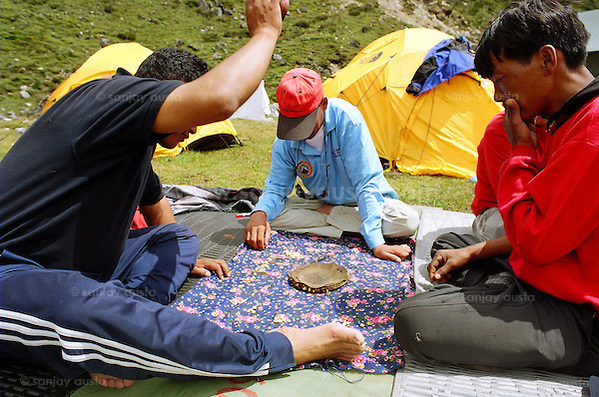
When not climbing the Sherpas are gambling- Ramche. Gambling is a serious activity among the Sherpas after climbing. For most of them its a good pass-time on the mountains when they have to wait for days for the right weather to make a climb. (sanjay austa austa)

When not climbing, the Sherpas are gambling. Ramche

As we explored Ramche and its nearby areas we saw glacier snouts spouting water from under them in broad steady streams..

Today, however, the Ramche lakes are innocuous beauties. They are shallow and on a clear morning sky, they reflect the surrounding 7000 meter plus peaks in their blue ripple-less waters. A magnificent sight especially when the grunting yaks ford across it in herds.

But should the glaciers melt continue at the present rate, it will be lakes like these that will spell disaster. Fed with unrelenting glacial water they will soon metamorphose into large natural dams. After a point their weak banks unable to contain the enormous water will break, wrecking unimaginable disaster in their wake.

How to get there: By Air: Fly to Katmandu. From Katmandu fly to Biratnagar. From Biratnagar fly to Sukhetar in Tapleyjung. From Tapleyjung one can trek up to Ramche.

By Road- Cross Nepal from Siliguri. Drive to Tapleyjung 17 hours away. From Tapleyjung one can trek to Ramche.

SA 014 (sanjay austa austa)

Glacial lake and the mountains, Ramche

Zakopane: The Architectural Gem in the Tatras

Tweet

 (sanjay austa sanjayausta@gmail.)

(Published first in the Deccan Herald, Jul 2015)

We left Krakow under an overcast sky and out on the two-hour undulating highway to Zakopane it drizzled intermittently and fogged up the views. Unless you are looking to ski, climb, glide or snowboard you come to the hills for the views. But the hill weather is unpredictable and there was no way we were going to see the splendor of the Tatra Mountains that looked so alluring in all the guidebooks.

We saw bits of them though, between the pines and the rising fog. Some had broad swathes of white running down their slopes. These were not the glaciers, Christopher, our guide, reminded us. Tatras have none. These were the ski slopes. Zakopane is Poland’s unofficial winter capital, attracting skiing amateurs and aficionados from across Europe and the world.

We had left Krakow full with the history of the place to a geographically isolated clime further south of Poland. Relatively untouched by the horrors of the Wars that had scarred Krakow and much of Poland, here was a place of quite and harmony.

The Tatra Mountains – the tallest mountains of the Carpathian Range - form a natural boundary between Slovakia and Poland. Mushrooming in their shadows are a host of towns among which the resort town of Zakopane is the biggest and the most popular.

 (sanjay austa sanjayausta@gmail.)

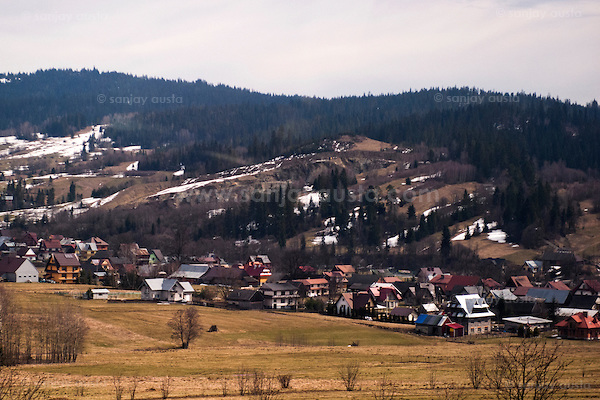
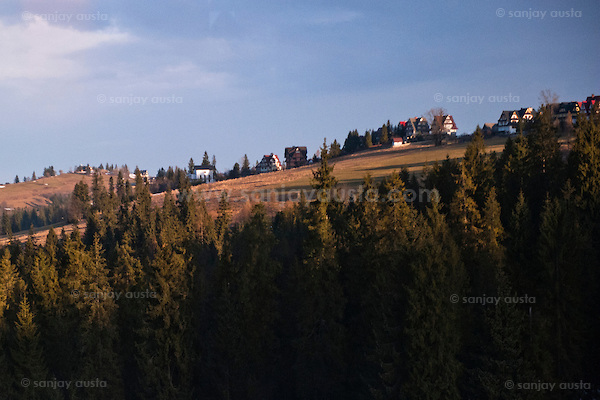
Battling rain and poor visibility we glided smoothly to this Polish town passing rolling hills with hamlets studded into their even slopes. The villages were but a clutch of houses, sitting amidst tidy farms with chicken running amok in the front yards. It was the advent of spring and some farmers were already atop their tractors tilling. A church with a high belfry was the most dominant building. Not surprising in a country with 80 percent Catholics who take their church attendance seriously.

It was an idyllic Central European rural setting one could say. Except this imagery was rudely broken by the occasional strip-club signs in the woods. A surprise, but promising unadulterated adult- fun for weekend revelers spilling out of Krakow.

Zakopane, however, despite the onslaught of tourism and technology, retains its Goral or Highland culture. It is there in their clothes, their music and their food. The attire is however only ceremonially worn. But it was the official dress for the waiters at a restaurant where we stopped for lunch. The restaurant with its cedar-wood ceilings and walls plastered with stuffed animals sought to recreate an otherworldly hunter’s den. A nightmare for any animal lover. But the good food was distracting. As was the local music which had an unmistakable Scottish lilt to it. No wonder then that the Zakopane dance is a group affair bearing uncanny resemblance to the Scottish Ball.

 (sanjay austa sanjayausta@gmail.)

But the Zakopane culture is synonymous with its architecture inspiring home construction not only in Poland but across Europe.

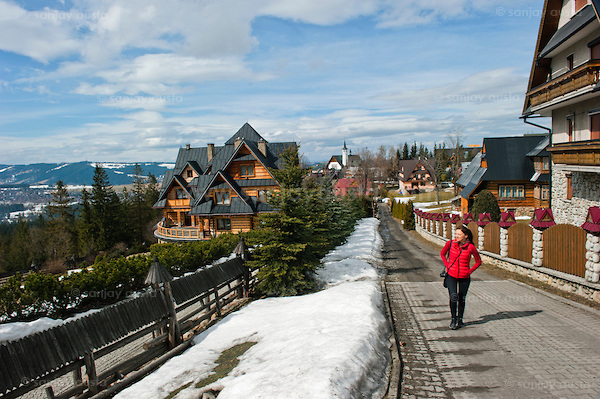
The houses look complex with an overlay of pattern over pattern. What makes the Zakopane houses look so distinct are the roofs. They are steep, usually over 70 degrees or more and have gables jutting out of them at different levels. These roofs are made of shingles or galvanized iron but in the older houses , the roof and sometime the entire building is hewn of wood.

We stopped by to marvel at the Jasczczurowce Chapel, an epitome of Zakopane architecture built by Stanislaw Witkiewicz, the man who popularized the Zakopane style. He built the church in 1904 and it was one of the many buildings that formed the blue print for what came to be known as the Zakopane style.

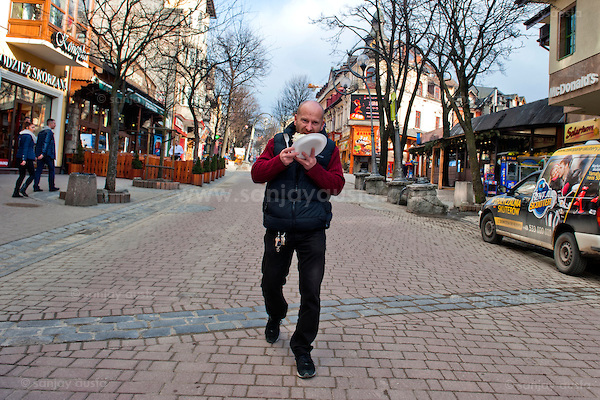
The best way to take in the beautiful architecture is to walk down Krupowki street- the main Zakopane street. Tidy row of houses line both sides of the near- empty street. There are small stand-alone stalls manned by women who sit inside them, selling condiments mostly made of local cheese.

 (sanjay austa sanjayausta@gmail.)

We didn’t see any tourists though there were many horse -carriages at the ready. The gabled houses, the stalls, the ubiquitous old churches and the horses with tufts of ankle -hair all lent an old world charm to Zakopane.

Too add to this, a short drive from Zakopane, are the mineral water springs. Our hotel Termy Bukovina had channeled the therapeutic waters into their pools where one could partake of what is believed to be waters with therapeutic and rehabilitation powers.

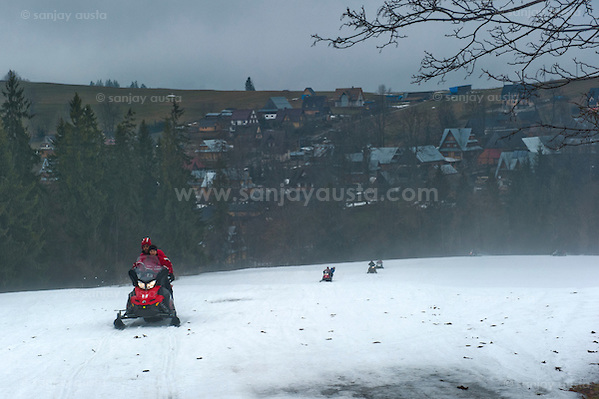
Perhaps we needed it for the next day when we went snowboarding in the Tatras. Snowboarding is the best option for any fly-by-nigh tourists who cannot ski and have no time to learn how to. You just sit on the machine and press the accelerator. To stop you simple let go the accelerator. But unlike Lapland where I had successfully ridden the snowmobile on the flat snowfields, I had trouble veering the machine in the steep Tatra slopes.

But then as we stopped for a barbeque lunch in a somewhat boggy forest clearing, I realized that what I may have missed in views, I had more than made up in experience.

 (sanjay austa sanjayausta@gmail.)

How to get there:

There are no direct flights to Krakow from India. Depending on what airlines one takes one has to halt to change planes in one of the several European cities. From Krakow Zakopane is 109 kms by road. It a less than two hour journey on the smooth highway.

 (sanjay austa sanjayausta@gmail.)